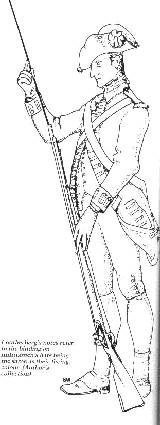
 (Picture shows an English militia private around 1778,
regiment unknown)
(Picture shows an English militia private around 1778,
regiment unknown)Alexander Cairens
I have traced my family line back to Alexander Cairens ( really Alexander Cairns ?), born around 1755 (from his recorded age at death). He served in the Northumberland Militia so I would have thought he was born in Northumberland, but the IGI index has no record of any Alexander Cairens or Cairns born anywhere in England between 1750 and 1760.
However the Northumberland militia records show that 11% of the men in Alexander's company came from Scotland, and the IGI have 6 Alexander Cairns ( but no Alexander Cairens) born between 1753 and 1758 in Scotland, so Alexander was probably one of these 6, but I have no way of knowing which one. Four of these came from Fife, the other 2 from Edinburgh and Fraserburgh. So my best guess would be Fife, but that is really the end of the records.
Going further back, I tried a genetic test for my male line. Oxford Ancestors said my Y chromosome ( the Cains/Cairns male line) is probably of Celtic origin, so descended from some of the earliest people to settle in Britain, rather than from any later invasions such as Anglo-Saxon, Norman etc.
And even further back, Genetree classify the Y chromosome as "haplogroup" R defined by the M207 mutation. The subgroup is R1b1b2a*-128. Long article with maps etc
Alexander joined the Northumberland militia in or before 1777, aged no older than 23. The English militia were selected from all the population by ballot, but most people who were chosen paid a substitute to take their place, so Alexander was probably one of these who took a payment. In peacetime the militia only had to attend a training camp for a few weeks a year. Unfortunately for Alexander the militia were called up for full time service ("embodied") in March 1778 when it became known that France had made an alliance with America to help in the American War of Independance.
(Picture shows an English militia private around 1778,
regiment unknown)
America did not win the War of Independance alone, but only after France, then Spain and eventually most of Europe declared war on Britain. The French and Spanish were eager for revenge after their defeat and losses of territory in the Seven Years war, and saw their opportunity when the American War of Independance broke out. The French fleet blockaded Chesapeake Bay in 1781 forcing the British surrender at Yorktown. Earlier, in August 1779 a French and Spanish armada sailed into the English Channel, with 66 ships carrying 30,000 men with the aim of occupying the Isle of Wight or perhaps Plymouth. Fortunately the French fleet had had to wait six weeks outside the Spanish ports waiting for the Spanish fleet to sail, so when they reached the English Channel the ships were short of supplies and struck by epidemics, and had to return to port. They hoped to try again next year, so Britain remained on full invasion alert.
By September 1779 Alexander's company of the Northumberland militia was commanded by Captain Hawdon Phillipson Rowe. There were 9 companies, a total of around 620 officers and men. The Northumberland militia were ordered to start marching from Newcastle to the East Yorkshire coast on 15th and 16th June 1779. ( It is a great advantage having an ancestor who was in the armed forces, so you can trace his exact movements from the military records). The militia tended to be posted away from their home county in case they had to put down any local riots (they would not want to shoot their friends and neighbours), and to reduce the chance of desertion. The militia were posted along the coast to help repel a full-scale invasion or local raids, and take action against armed smugglers.
Six of the companies of the Northumberland militia were billeted in Beverley, 2 in Bridlington, and one scattered along the coast at Hornsea, Skipsea and Mappleton
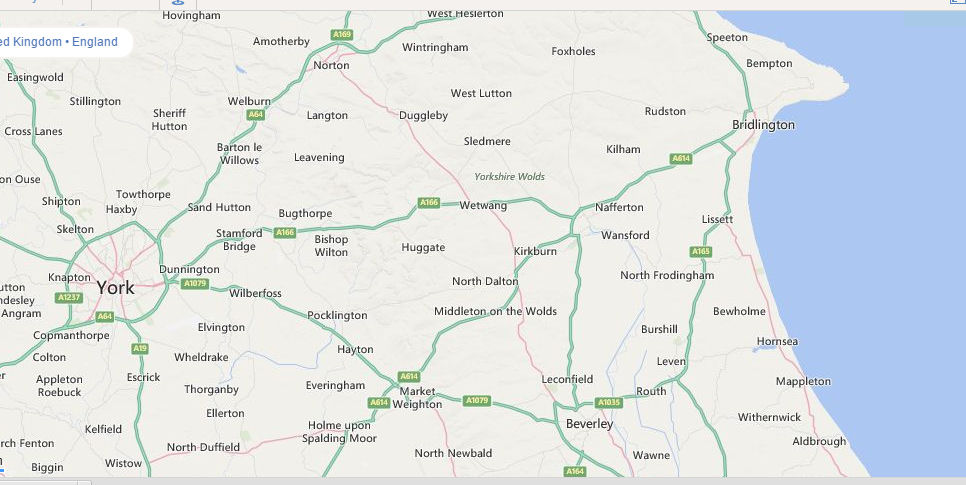
Other county militia were guarding the important city and port of Hull. Most militia in England at this time were billeted in overcrowded pubs, except those in organised camps around London.
The York Courant newspaper described a ball held by the officers of the militia :-
Nov 16th - We hear from Beverley that Lord Algernon Percy and the officers of the Northumberland Militia, quartered at that place, Hornsea, and Market Weighton, gave a ball to the Ladies and Gentlemen of that neighbourhood, which was numerous and extremely brilliant, particularly the ladies, who excelled in Taste and Dress any Thing behold in those parts before.
However, there was a serious side to the duties of the Northumberland militia. In September 1779 John Paul Jones sailed his fleet down the Yorkshire coast leading to his famous battle with the British ship Serapis off Flamborough Head. (He is now almost unheard of in Britain, but his phrase "I have not yet begun to fight!", after a four hour battle with his ship almost destroyed beneath him, is famous in America.).
The two companies based in Bridlington were on the front line. The Newcastle Courant printed a letter from Bridlington:-
"On Tuesday the 21st inst, about eleven o'clock at night, the piquet guard of a detachment of the Northumberland militia gave the alarm of several light colliers being chased and fired at in the Bay by Paul Jones's fleet; upon which the drums were beat to arms, and in less than a quarter of an hour both officers and men were upon the pier, eager for action in case he should attempt to land; and from that time lay every night upon their arms until Paul Jones's fleet left this coast. Too much cannot be said of Major Surtees, Capt Wood and the other officers, for the strict attention they paid the whole time Jones was on the coast; their steady adherence to military discipline has endeared them very much to the inhabitants of Bridlington and the neighbourhood."
Another letter from Bridlington dated Sept 28th gave more details :-
"When Paul Jones's squadron appeared off Bridlington Quay, and had actually threatened the town, and shipping which had sheltered themselves in the harbour amounting to nearly 40 sail of colliers; the masters were requested, for the security of both, to mount their carriage cannon on the pier, which might have been done very easily, as there were upward of 200 sailors ready to execute the work instantly; but not one captain except Captain Greathead of the Kitty, would lift a hand. He alone got his cannon mounted with the greatest expedition and if the rest had done the same, 40 or 50 guns might have been mounted, and brested so as to have made a compleat battery."
A letter from Beverley noted "The two companies of the Northumberland militia which marched hence from Bridlington on Wednesday afternoon, returned hither on Friday morning." Perhaps my ancestor was in one of these companies, a small place in history.
There were similar alarms and hasty preparations for defense in Hull (details)
I wrote a podcast about these events, that can be played here https://thehistorynetwork.org/2610-john-paul-jones-the-american-war-of-independence-comes-to-britain/
My ancestor's company, commanded by Captain Hawdon Phillipson Rowe, was moved on 5th October 1779 to Market Weighton, further inland. This may be because Beverley was rather overcrowded. Men were usually billeted in overcrowded pubs and houses. ( After the Northumberland militia were posted down south, the Mayor of Beverley in May 1780 pleaded for some of the newly billeted militia to be moved away to ease overcrowding). The monthly returns give the commanding officer of each company, and show Captain Rowe's company in Market Weighton from November onwards. The annual returns of the militia give the number of men in each company who came from different countries, so in 1779 we can see Captain Rowe's company including Alexander Cairns had 65 men, of which 58 were from England and 7 were "Scotch" (11%). None were Irish or foreign. The men in this company were fairly short, only one was above 5 ft 9 inches.
Alexander married in Market Weighton in February 1780. His banns of marriage said he was "of the Northumberland militia, quartered in this parish", but for his marriage in the following week he was described as a labourer, so he presumably left the militia around this date, having served his full time. He missed the most serious action of the Northumberland militia, putting down the Gordon riots in London later this year.
Click here to see Alexander's family in Market Weighton. I have recently traced several Cains relatives descended from his children.
Sources -
If anyone is interested in these topics or has more information about the Northumberland militia, please send me an email, to simon @ cains . myzen .co .uk (without the spaces)